Friday, November 2, 2012

Guns, Germs and Real Estate

My first glimpses of Plum Island, like most people’s, were from afar. I grew up in Wading River, amid cabbage fields and subdivisions, and when we made the 40-minute drive out to the tip of the North Fork, usually on the way to somewhere else, the island had a way of peeking into view.

As a kid in the ’80s, the ospreys’ nests and oyster beds that lined the route to the Cross-Sound Ferry terminal in Orient didn’t have much allure to me. I didn’t know then how precious the pockets of nature, and the moments of quiet, would come to feel as the undeveloped parts of Eastern Long Island got smaller and smaller. The fresh golf courses and the build-to-suit signs didn’t yet feel ominous. 

What never failed to transfix, though, was Plum Island. On school field trips to Boston or Mystic Seaport, we’d crowd up against the ferry railing and squint through the fog of Plum Gut toward the low beige buildings with smokestacks and ventilation pipes lining their roofs. Our knowledge of the island, and the gaps in it, added up to fascination. We knew it was a lab; we knew they experimented on animals; we knew there were diseases there that were best separated from the mainland by a cold, choppy body of water. And when “The Silence of the Lambs” came out when I was 14, we knew it was a place even Hannibal Lecter wouldn’t want to live.

“Anthrax Island,” the cannibal doctor called it, and he wasn’t alone. Real events there – a power outage, multiple disease leaks and an early history of weapons research – mingled in the popular imagination with the Montauk Monster and the stuff of campfire stories. 

“Look at that place,” wrestler/governor Jesse Ventura intoned years later, bobbing in a boat offshore for his conspiracy-theory TV show. “It’s a toxic ticking time-bomb for an outbreak of cataclysmic proportions.” 

How, then, could I pass up a visit?

*

It would have been unthinkable decades ago, but Plum Island today, under the auspices of the Department of Homeland Security, is open for tours. They don’t make it easy – there are background checks and restrictions, and forms to sign with warnings not to visit farms, zoos, stockyards, “various menageries,” or pet stores for days afterward. But by the time I showed my ID to a security guard in Orient and boarded the morning boat to the island on a clear day last spring, I had been preceded by Cub Scout troops, bird-watchers and volunteer firemen. 

I was there as a magazine reporter, a species that the island’s government minders now found surprisingly welcome, in large part because of Plum Island’s uncertain future. With plans to move the lab to Kansas and sell the island weaving through the branches of the federal government, Plum Island was now more than just the site of a secretive animal disease lab – it was real estate. I had an escort from Homeland Security, whose name I had to promise not to print, and two more from the General Services Administration, the branch of government that sells off excess property.

After processing on the island we loaded into a van and rode, past the vine-covered remains of Fort Terry and through a weedy former parade ground, to the East End’s quietest beach. The fort, dating to the Spanish-American War, once housed hundreds of soldiers but was declared surplus after World War II. Now, by the island’s southeastern shore, there were a volleyball court and a horseshoe pit used mostly on the lab’s family day, and a lifeguard chair that lay on its side. Except for scraps of driftwood, a spider crab shell, and a stray thermos and Wiffle Ball washed up from points west, the long stretch of white sand was pristine. And with good reason: Besides environmental protection specialists who pick up trash regularly, security guards on foot patrol do what they can to tidy up.

Cool water lapped at the beach, and crickets chirped in the field nearby. The view to the south, across Gardiners Bay, took in the broad sweep of the Hamptons. To the east was Block Island, and wide open ocean.

“Just watch your step,” my government escort said. “Because sometimes out here, you find little tortoises.”

*

Here is Plum Island’s greatest secret: It’s beautiful. The landscape, wild and untamed, is a taste of what the rest of Long Island must have looked like before all the people came. All it took to preserve it were a few buildings, on a few small lots around the island’s 840 acres, with enough contagious pathogens inside to scare away the world. 

But life abounds. Along the rocky northern shore, where purple beach blossoms line the road, an emergency medical technician out for a walk in the days before my visit came upon an injured red-tailed hawk. Other workers have spotted bald eagles. I saw a seal poke its head out of the water, one of hundreds that stop at the island in cold weather on the way to their breeding grounds. And nature, over the years, has been reclaiming territory. 

At the island’s eastern tip, down a bumpy gravel stretch of road, is a cluster of heavy concrete fortifications that once held gun batteries to defend the east coast from air and sea attack. Now they’re overgrown with weeds and brush. 

Another look at the horizon offered a hint of Plum Island’s possible futures. To one side, Gardiners Island, five privately owned square miles off the coast of East Hampton with their own history of development intrigue.  To another, Fishers Island, a playground for the wealthy with a military background much like Plum Island’s. Finally, in the distance, Little Gull Island, a tiny outcropping that was government-owned for the moment – though the GSA was on the case.

“The lighthouse sits on an acre of land,” one of the GSA guys said. “So we’re going to sell that.”

We stopped at another gun battery, where a brick room once used to house ammunition now held a drum, marked “non-hazardous waste.” Poison ivy lined the path in and out, and when we emerged, we all stopped to pick ticks off our pant legs.

It was the ticks, later, that nagged at me. When you’re on an island rumored to be the birthplace of Lyme disease, little things can unsettle. So can bigger things, like the ghostly block of a structure, near a spot called Pine Point, that once held the island’s biological weapons lab. First built to store mines, it was vacant now, its entrances sealed shut and its cinder-block walls covered in peeling paint and vines. A barbed-wire fence ringed its perimeter. Fifty feet away was the beach, long and empty. We stood on a gun fortification and took it all in.

“This could all be yours,” someone mumbled.

*

A place like Plum Island, though, is not disposed of easily. In the months after my visit, the funding for the Kansas lab dried up and talk of Plum Island’s sale went quiet – though the real estate listings remain. (My magazine story dried up, too; not enough conflict, the editor said.) There were also questions about the island’s real worth. Optimists in the government had floated sums of $100 million. A real estate agent told me he’d guess more like $40 million. Let’s say you build a house there, he said. Would you want your kid digging in the sand?

But maybe the island’s value lies beyond money. Much of Long Island, after all, was empty a century ago. Since then the wide roads and housing grids have spread ever-eastward, over woods and potato fields and most everything else in their path. In Southold, a few miles from Plum Island’s shores, real estate offices tout mansions priced in the millions of dollars and undeveloped lots for almost as much.

In context, 840 acres of wilderness – even 840 acres of wilderness with a carcass incinerator – begin to look precious. 

“Is everything really reduced to the marketplace?” Bob DeLuca, an East End activist, asked me. “Is everything just always for sale? Is everything always at a price that somebody can buy it if they have enough money? Or are there some things that we’re going to step back and say, enough?”

Perhaps Anthrax Island is an odd place to take that stand. But from the shoreline near the old weapons lab, as a breeze blows off the bay and a family of geese edges into the water, it looks like the best place we have left

So anyway ...

Oh, hi.  I've been meaning to post this next piece forever. It's based on reporting that I first did in the late spring of 2011 for a magazine story that never ran. I later rewrote it entirely for a contest I didn't win. It never really found a home, but I still like it -- which is to say, it holds a very special place in my heart and I'm proud of it despite its weird process of coming into being. Fortunately the editor here lets me post whatever I want.

I can no longer vouch for the accuracy of current events, but the sentiments I'll stand behind. Please enjoy.

Monday, June 4, 2012

I can't believe I forgot Carl Bernstein

This was one of the best ones.  I'm actually going to paste this into my earlier post about celebrity writer encounters, but I figured, for people who aren't obsessively reading that post over and over again (and why?), it might be easier to find here.  So:

Carl Bernstein, reporter. April 2007
I was in Sag Harbor to write a story for the Escapes section (R.I.P.) about a rich guy's vacation home. At first I thought it was Bob Weinstein, the movie producer, but then they said no, it's a different Bob Weinstein. As it turns out, this Bob Weinstein probably has much cooler furniture -- not that I'm familiar with the movie producer's furniture, but this Bob made a pastime of scouring antique stores and Manhattan flea markets for mid-century modernist pieces: Eero Saarinen tables and whatnot. So I'm in Sag Harbor to see this house, and we decide to take a walk over to a design store that he particularly likes -- partly so I can get more of a sense of his decorating sensibility and partly, I imagine, so he can get his friend's store in the paper. In the store, a sort of schlubby older guy is browsing the driftwood candle holders or whatever, and I think, "That dude looks familiar." Bob Weinstein apparently had no such thought, but being in a chatty mood said something about the weather. They before you know it, they're hitting it off, going back and forth on the virtues of in-town vs. waterfront property in the Hamptons.  (As I recall, the feeling is that waterfront is nice but then you've got to worry about global warming.) All the while, my mind is locked in on a question: "Hey, is that Carl Bernstein?" I didn't want to interrupt, for some reason, and we're actually about to leave the store, when finally Bob Weinstein introduces himself to the guy. And the guy is like, "Nice to meet you. I'm Carl." I finally can't take it anymore, and say, "Carl Bernstein?" He says yes and I say, Oh hi, I'm a reporter and a big fan -- Watergate, etc. -- and I'm writing a story about this guy's house ... pointing over at Bob, who has kind of a blankish look on his face while he tries to remember who Carl Bernstein is. He eventually caught up, though, and I think we then talked about whether Hillary Clinton was going to get elected president. (Did Bernstein say no? I think he might have said no.)  And then Bob Weinstein, having fully recovered his bearings, invited Carl Bernstein back for a tour of his house. Bernstein -- who if he wasn't wearing flip-flops might as well have been -- said what the heck, and we all trouped over there on some narrow village street, and checked out the work in progress on the pool house. The Hamptons are so weird.

Cool story, bro

Really fascinating reading about this guy's day at the Johan Santana no-hitter. Though maybe next time they might consider giving that precious Sunday-paper real estate to ... someone who likes baseball? ... and cares to explain it to his kids? ... and knows how to read the scoreboard? ... and is AWARE THAT HE'S WATCHING A NO-HITTER? Otherwise, solid stuff.*

The crazy thing is that, just off the top of my head, I can think of another person who was at the game with his kids, who satisfies all of the above criteria, and who happens to be a professional writer and contributor to the Times. But not a staff writer, so probably nobody thought to ask for his impressions. Sigh.

Which reminds me, did I ever mention that I'm in this book?  I had avoided buying it for years, because somehow paying for edited-down versions of my own work, shortly after the section in which that work appeared was eliminated to save the publisher money, didn't seem palatable.  Also, in the introduction Anna Quindlen, who seems nice, made a point of saying that all stories in the book were written by Times staffers. Ha ha ha, I wish, right?

Anyway, I finally caved and bought it recently, and it's a pretty good read and a lovely keepsake.  I'd suggest purchasing it the way I did, by letting Amazon find you a used copy online. It's a fraction of the price, and you know that at least some of your money is going to support a business that really deserves it: A used-book store. They are a dying industry, after all.


* Not really. (Just so as not to be a complete hater, I should acknowledge that the same reporter has written really, really good things in recent months.  Just not this.)

Wednesday, May 9, 2012

Book Signings I Have Attended (And Other Encounters With Notable Writers)

Seymour Hersh, investigative reporter. October 2004
He had an event in the New Yorker Festival, promoting his book, "Chain of Command," which was great even the revelations in it about the Bush administration didn't end up making much of a difference, politically speaking. He comes across as intense and possibly crazy in a lot of the profiles you read of him, but was really sweet. When I got up to his table I told him that he had spoken at my journalism school commencement a couple of years earlier. He smiled and asked what I was doing now. I actually wasn't doing half bad at the time, but got embarrassed and stammered something about writing very short things in the Times, nothing nearly as important, of course, as what he did. He said, "That's OK -- you just have to get a toehold in the business, do whatever you can do. Stick around and you can write the things you want later."
Inscription: "For Jake -- Thanks for coming. Seymour Hersh, New York, Oct. '04"

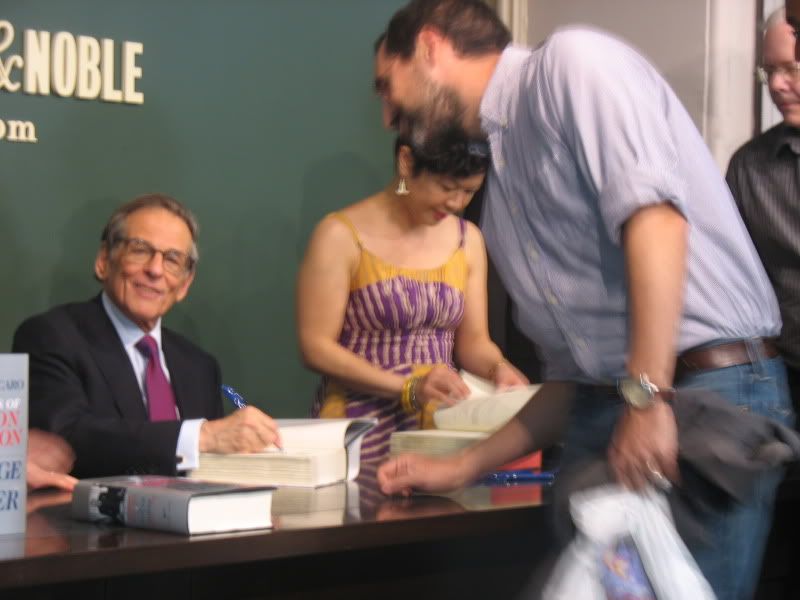
Robert Caro, biographer. April 2007
He gave a talk at the journalism school and they invited alumni to attend for free -- which was nice, because Columbia usually tries to wring every last dollar they can out of you, even though you've already paid them $30,000 or so for a degree in a field with no jobs.  Ahem, anyway.  I took the train uptown from Brooklyn on a Wednesday afternoon and there he was in the lecture hall, looking dapper in a tailored suit as always. The hall was, depressingly, about 40 percent full. (J-school kids: The Worst.) I remember he talked about Lyndon Johnson a bit, and the Power Broker a bit. This was during a time when there was a lot of Robert Moses revivalism going on -- "Does New York need another Robert Moses?" and other such silliness. He seemed kind of peeved about it. When somebody asked him about a historian who had disputed one of the facts in the book, he said, "What historians don't understand is that you can call people up on the phone and ask them these things," and he detailed how one of Moses' cronies had been the direct source of the disputed information in a conversation they had. I had previously found a hardcover first edition of the Power Broker at the Strand, and brought it for him to sign. I tried to say something about how important his work was to my life and career but got way flustered and just sort of thrust it at him and robotically told him my name. Meanwhile some undergrad, the editor of the Columbia Spectator or something, asked him if he'd meet their staff for a beer, and he said yes without hesitation.
Inscription: "To Jake, from Robert A Caro"
Bonus inscription, from the book's original owner: "To Maria, Merry Christmas 1974, Your husband with love," with an arrow pointing to a spot in Westchester on the map at the front of the book. Next to it, it says "our house."

David Samuels, magazine writer. Winter/spring 2003 sometime
OK, so it's a step down in famousness, but the guy is great. Check out his piece about Woodstock '99, or about Stevie Wonder playing the Super Bowl halftime show (both available in his book, "Only Love Can Break Your Heart," though not, alas, for free on the internet). He talked to my j-school class about how hard it is to make a living as a magazine writer, recounted having lived in Jersey City with heroin addicts to make ends meet. He's fine now: In Cobble Hill, I think, with equally successful journalist wife. And I didn't ask him to sign anything. But I still think about that story, even though the lesson in it seems to keep changing on me.

Jonathan Mahler, magazine writer. 2005 sometime
Went to hear him read from "Ladies and Gentlemen, the Bronx is Burning" at the Barnes and Noble in Park Slope. Afterward waited in line to get it signed, hoping to strike up a conversation with him about 1977, the year of my birth and the subject of his book. Thought I might tell him about this story my mom tells, about how she, pregnant, was driving in the city with my young female cousin, and their car broke down, right around the time the Son of Sam was still at large. They were fine, obviously, but it was scary at the time because basically everybody was totally freaking out about everything. I was almost at the front of the line, thinking all this over, when the guy directly in front of me struck up a conversation of his own with Jonathan Mahler. I guess they were neighbors or something. Mahler, still talking to the other guy, reached for my book to sign it without even looking up. For some reason, like it was a really important thing to tell him, I said, "I'm really interested in your book because I was born in 1977." He looked up then, and said, "Oh, in the city?" and I said, "No." He looked at me for a second, confused, and turned back to to his neighbor, handing me my book.  A while later I read it and thought it was just OK, kind of a missed opportunity. A while after that I sold it for a dollar at a stoop sale.
Inscription: unknown.

Tom Vanderbilt, magazine writer. December 2010
He writes about transportation issues for big magazines. It's a good gig, because if some nobody off the street pitches a story about transportation issues to one of these places, that person gets told thanks but no thanks because that stuff is generally regarded as boring as hell. But this guy does it well, and has made a real career out of it, which is great. He wrote a book about traffic. I didn't go to any kind of a signing, though, and in fact haven't read the book, though I keep meaning to. When I met him was when I bought a used office chair from him -- a white mesh knockoff (but a pretty good one) of an Eames "Aluminum Group" management chair. His wife turned out to be Jancee Dunn, also a writer, who I very specifically remembered from when I was obsessed with Rolling Stone as a teenager, and also from when she was an MTV VJ. Got a little starstruck, to be totally honest. They lived in a building I had always wondered about, a converted church I used to walk past, and they actually knew my stuff somehow, and said nice things about it. I mentioned that my wife was pregnant and we talked about babies for a while. I left their place thinking, "Jeez, you really can, theoretically, make a living doing this." The chair is still in good shape.
Side note: Around this same time I also sold our portable dishwasher to Bryce Goggin, a record producer best known, to me, as the guy who played piano on Pavement's song "Range Life." Craigslist is amazing.

David Simon, former journalist and creator of The Wire. March 2007
He talked at the j-school (it was free, too, though I think as alumni we may actually have had to sneak in). Most of what I remember is the incredibly pompous moderator, a student, naturally (j-school kids: Terrible!), who mostly held forth on why, in his opinion, the Wire was important to society. But Simon got to speak too and it was probably good -- though, from what I vaguely remember, pretty ornery at times. I had recently read his first book, "Homicide: A Year On the Killing Streets," which had been the basis for one of my favorite shows in high school, "Homicide: Life On the Street." NBC aired it on Friday nights so basically nobody watched it. But I was a dork and never had plans so I sat home with my mom and caught basically every episode. Anyway, the book was good, and I brought it to the talk. There was no official signing and I was a little bummed, but then afterwards I happened to see Simon on the downtown subway platform at 116th Street. I psyched myself up and went over to him and asked him to sign my book, and he did, and it would have been great if things had ended there. Unfortunately the train came right then, and we ended up getting on next to each other, and standing near each other, awkwardly. For some reason I tried to make conversation by saying something like, "Man, j-school kids -- terrible, huh?" He looked annoyed. I realized, too late, that he couldn't know I was a former j-school kid, and therefore that I was being at least a little bit self-deprecating. He muttered something like, "I thought it was a nice event," and then I didn't know what to say. After a long pause I asked him if his show about New Orleans had gotten a green light, and he said they weren't sure yet. Then he looked at me and I looked at him and I decided to go sit at the other end of the car.
Inscription: "All Best - David Simon 3/26/07"

Dan Barry, New York Times columnist. 2007 sometime
His columns about New York City, when he wrote for the Metro section, were great. (Check this one out for a taste.) They're compiled in a book called "City Lights: Stories About New York," and I went to see him read at a Barnes and Noble, I think, near NYU. At the time I was writing for the City section, and was about to start writing the section's front-page column, and he was somebody I specifically wanted to model my work on. There weren't a ton of people there, and I spotted a few people I recognized from the Times, but there were also some people who were obviously very devoted readers. Afterwards I got in line to get my book signed, and when it was my turn he started asking me all kinds of questions about myself, and acting sincerely interested, too. I didn't even get a chance, until after he had signed the book, to mention that I also wrote for the Times (though as a freelancer, as they were always careful to make sure I understood), and was starting a column. Eventually I got brave and told him, and he was really nice.  There was talk that we'd have coffee sometime and talk more, but it never worked out, for boring scheduling reasons. I still make a point of looking for his stuff, though.
Inscription: "To Jake -- From Long Island, now in Brooklyn -- like me. Dan Barry"

Carl Bernstein, reporter. April 2007
I was in Sag Harbor to write a story for the Escapes section (R.I.P.) about a rich guy's vacation home. At first I thought it was Bob Weinstein, the movie producer, but then they said no, it's a different Bob Weinstein. As it turns out, this Bob Weinstein probably has much cooler furniture -- not that I'm familiar with the movie producer's furniture, but this Bob made a pastime of scouring antique stores and Manhattan flea markets for mid-century modernist pieces: Eero Saarinen tables and whatnot. So I'm in Sag Harbor to see this house, and we decide to take a walk over to a design store that he particularly likes -- partly so I can get more of a sense of his decorating sensibility and partly, I imagine, so he can get his friend's store in the paper. In the store, a sort of schlubby older guy is browsing the driftwood candle holders or whatever, and I think, "That dude looks familiar." Bob Weinstein apparently had no such thought, but being in a chatty mood said something about the weather. They before you know it, they're hitting it off, going back and forth on the virtues of in-town vs. waterfront property in the Hamptons.  (As I recall, the feeling was that waterfront is nice but then you've got to worry about global warming.) All the while, my mind is locked in on a question: "Hey, is that Carl Bernstein?" I didn't want to interrupt, for some reason, and we were actually about to leave the store, when finally Bob Weinstein introduced himself to the guy. And the guy was like, "Nice to meet you. I'm Carl." I finally couldn't take it anymore, and said, "Carl Bernstein?" He said yes and I said, Oh hi, I'm a reporter and a big fan -- Watergate, etc. -- and I'm writing a story about this guy's house ... pointing over at Bob, who has kind of a blankish look on his face while he tries to remember who Carl Bernstein is. He caught up, though, and I think we then talked about whether Hillary Clinton was going to run for president. (Did he say no? I think he might have said no.)  And then Bob Weinstein, having fully recovered his bearings, invited Carl Bernstein back for a tour of his house. Bernstein -- who if he wasn't wearing flip-flops might as well have been -- said what the heck, and we all trouped over there on some narrow village street, and checked out the work in progress on the pool house. The Hamptons are so weird.

Pete Hamill, famous writer. March 2008
My friend and fellow reporter Jeff and I went to see a panel on column-writing that the Times put on. It was a thing they sold tickets to, to the public, but I somehow wrangled free ones, on account of being a freelancer with a column myself. Not that getting the tickets was easy for a person in that position, but they did materialize. Dan Barry was there and Jimmy Breslin, who was pretty cool, and Pete Hamill and some others. My dad is a big Pete Hamill fan, so I had tracked down this memoir he wrote about how he gave up drinking (I'm fuzzy because I didn't actually read it myself).  It was not super easy to find in my local stores but I got it, and went to the talk, which was good. Afterwards I waited in line to see Hamill, and when I got up to the front, tried to say something about how I always admired his writing and my dad was a big fan, but he just sort of grunted and held his hand out for the book and looked past me at the next person in line. I dunno, I don't want to say he was a jerk. Bad day, maybe? I had planned to borrow the book from my dad and read it, but decided nevermind.
Inscription: unknown.

Jon Lee Anderson, New Yorker writer, biographer, international journalist. September 2005
This guy writes incredibly ballsy stuff from places that most people generally try to avoid going to. I'm thinking of one piece where he hung around with gangsters in Rio, basically risking his life. Also Iraq, Egypt during their uprising, etc. And it should be said that this is not a young guy, or one who especially needs the money.  He was doing a talk at the Union Square Barnes and Noble, I think about his Iraq book, and we really wanted to go. Laura, having read him more, especially wanted to go. Anyway, we missed it for some reason, but went to the Barnes and Noble anyway and were hanging around and happened to spot Jon Lee Anderson, alone, sort of packing up his things to go home. Laura didn't want to bother him, but I, being generally the pushy one in the relationship, said I'd go over. I grabbed a copy of his Che Guevara biography off the shelf and walked up to him and said, "Excuse me, are you Jon Lee Anderson?" He said yes and I explained that it was almost my wife's birthday and we were big fans, even though we had missed his talk for whatever reason. He signed the Che book, and was really nice!
Inscription: "For Laura, With my best, on your birthday. Jon Lee Anderson, NYC 9/25/05"

Saki Knafo, Caroline Dworin, Greg Beyer, Katie Bindley, me. November 2010
We were all in a compilation of stories from the City section, which I think it's fair to say we all loved working for and missed a lot at that point. And still do, though I guess if you said some of us (me) need to move on, I'd concede your point.We all read our stories (and Helen Benedict, too, who is a way bigger deal than us but was totally gracious about that), and then afterwards there was a stack of books for us to sign. I remember a moment, when I was writing, "Thanks for reading! -- Jake Mooney" in book after book, when I thought to myself, "How is this not vandalism?" Though of course now, those guys are basically all legit famous, with hundreds of Twitter followers and whatnot, and I'm Pete Best or something. Still, I'm just saying that writing your name in a stranger's book is weird, and I wonder if it ever stops feeling that way.

Robert Caro, biographer. May 2012
He was at Barnes and Noble (who I swear is not paying me a fee for mentioning them so many times in here). I got there at the last minute and sat in the literal back row, about 50 yards away from him, before deciding to stand up, in an area behind that. The guy next to me let me borrow his binoculars, and later leaned over to say that he had been a teenage volunteer, in West Virginia, on some of Lyndon Johnson's anti-poverty programs. Caro's talk was great as always, and actually made me a little teary-eyed when he talked about the poverty Johnson came from and how, consequently, he hated injustice for the rest of his life. (Not that he, Johnson, wasn't a complete dick a lot of time too, which Caro also chronicles in detail.) At the end of the talk they let people up to get their books signed, row by row, which meant that I was one of the last people to go up, out of hundreds. I decided it would be cool if my friend Wolfgang could take a picture of me with Caro, and gave him my camera. I got up to the podium, which was when I realized just how fast Caro was signing these books -- really fast, faster than you might think possible. It was a whole system: One of his assistants took the book from you and opened it to the proper page, then lined it up on the table next to all the other people's books, sliding the whole row down every couple of seconds as he wrote. Then a different assistant whisked each signed book away from him and handed it back to you. Maybe because it was getting late, I was getting serious Santa-Claus-in-A-Christmas-Story vibes. With the angry elves (though in this case, with degrees from Brown or wherever) herding everybody along. So I put my book down for the one assistant, took a deep breath, and said, in my friendliest voice, "Mr. Caro, could I take a picture with you?" He smiled and said, "Sure," and I said, "Well, my friend is right over ..." at which point both of the assistants, and I think maybe some other people too, started whisper-shouting, "He can't pose for pictures! He can't pose for pictures!" Before I knew it my book was signed and back in my hands and I was down from the podium, standing next to Wolfgang, who is a great computer programmer but maybe not the quickest photographer (though to be fair, my camera is crap).  Long story short, here's the picture he took:

Inscription: "Robert A Caro"


Wednesday, April 4, 2012

Some Running Videos

Hey, here are some running videos.  Basically I've been geeking out watching them lately, and I should be in bed right now, but I don't like seeing a two-month-old post at the top of this thing.  So check these out!  I think they're great as drama, even if you're not into running.

They're also a corrective to the tendency that a lot of Americans (myself included, I admit) have to lump all African runners together.  Like, "the Kenyans," or, "the Ethiopians."  There are a lot of colorful personalities on display here if you can get past the hard-to-pronounce names. Especially Sammy Wanjiru, R.I.P.

Oh, and another thing they're a corrective to: people getting obsessed and/or dogmatic about form. Don't get me wrong -- form is important and I think about it all the time.  But in this class I coach I was lecturing people about not holding your arms too high, not swinging them side to side, etc. etc. And some of these guys break a whole bunch of "rules" (even sometimes heel-striking ... the horror ... the horror), all while running 4:30 miles for two hours straight.  So hey, whatever.  To an extent, I think you run how you run.  But, you know, first world problems.

Anyway, without further ado. The first one is my favorite but the second one is pretty badass too.


Monday, February 13, 2012

In Honor of the Grammys

Not really, actually. It's just a coincidence that I wanted to do a music post this week. I was driving around listening to the radio the other day -- I think it was WFMU -- and heard some good stuff that surprised me, and it reminded me of some other good stuff that I had weirdly always dismissed but had just recently found myself liking. And since the Grammys are about nothing if not ignoring and dismissing good music, it seemed like a worthwhile tie-in.

So yeah, I was driving around, scanning through the preset stations on my incredibly crappy car's even crappier stereo, when this came on:


Now I had heard this song lots of times, of course. I listened to a ton of "oldies" radio as a kid, because that's what my mom always had on the car stereo. But somehow I never really registered the, I don't know, vehemence, of way this guy, Levi Stubbs, sings this. I somehow did not remember the Four Tops having this much soul.  Silly me. (There's going to be a lot of that in this post.)

Also, you don't totally get it in that live clip, but hearing the studio version through my car's speakers, I was struck by the robustness, the fatness, of the orchestration behind them. I've heard a bunch of times that a lot of Motown songs were produced in a way that basically optimized them for car stereo speakers. The consequence being that they sound perfect in a car, which is where the producers figured most people were going to hear them in those days, whereas they actually sound kind of crappy through a much more expensive high-end stereo. There must be something to this, because this song sounded great.

A short time after it was over -- maybe immediately after, which is the beauty of WFMU -- this came on:


When it first started, I didn't even recognize it as a Bob Dylan song, which is kind of something, because I'm a pretty big Bob Dylan fan. Not a going-through-his-trash kind of big fan, necessarily, but the kind of big fan who at least knows the name of the guy who went through his trash.  At the very least, I thought I knew all of his good songs.  But this, obviously, is a good song, and I didn't know it.

The thing that really gets me is that I got most of my early exposure to Dylan by playing my dad's old records when I was a kid/teenager.  And my dad definitely has this record, which I remember specifically because I played it -- once.  I must have been going through a period in which I was obsessed with a different era of Dylan, most likely the mid-60s electric rock stuff that's still my favorite. Because all I remember is that I put it on, listened to maybe one side, though more likely just a song or two, and was like, "This sucks."  And then didn't revise that opinion again for something approaching 20 years.  So, oops.  One annoying consequence of that chain of events is that I don't even have the record on vinyl -- and I've got my share of minor and kind of shitty Dylan records. (Like, I dunno, Knocked Out Loaded, the totally excellent Brownsville Girl notwithstanding.)

What I'm saying is, if anybody wants to give me a copy of New Morning, I'd take it.

A much less youthful error in judgment, I was thinking the other night, involves Fugazi. These guys have never done it for me, which has always been vaguely embarrassing, because you hate to be the wimp who doesn't like punk rock or whatever.  I'm honestly not even sure if I was adequately differentiating between them and other punk, or hardcore, or whatever they are. (Are Fugazi hardcore? God, this is making me feel lame.) I just knew they were kind of shouty and I wasn't into it. Well, long story short, I fell down a Youtube hole the other day and am, if not a hundred percent rehabilitated, then at least feeling a lot more open-minded.

I think what I had been missing, to my discredit, was the percentage of their sound that comes from reggae -- the jumpy rhythms that make them kind of danceable in ways that don't involve punching people in the face. (Not that Fugazi would condone such violence, of course.) Their danceability is on infectious display here:


I think if I could be one guy in Fugazi it'd have to be the guy who could dance like that ... even if he was also sort of responsible for emo.  I'd want to borrow Ian's guitar, though.

Last on my list of weirdly overlooked stuff is Husker Du, another band that I also got obsessed with on Youtube the other night, and that I have no real excuse for not being into before. I like the Replacements, who were from the same time and place and engaged in similar substance abuse and let it affect them similarly. And a bunch of years ago a friend gave me a burned CD of "New Day Rising," probably their best-known record. I don't know what to say; something about it just put me off.  I think it was actually Bob Mould's guitar tone. That might sound a little crazy, but if anybody's guitar tone can be polarizing, it's Bob Mould's.  And I like loud guitars, too. This just, at the time, seemed to cross too far into abrasive territory.

So, maybe I've changed or maybe I just wasn't listening very well then, but what I missed, in Husker Du's case, were the strong melodies behind all that blaring and scraping. This isn't their song, but it's too good not to link (and I went with the audio-only clip because of sound quality) :


They have lots of great songs that they wrote, too, obviously. Let's just call that homework, for all of us.

So there you have them, my lapses in taste, laid to rest at long last. Everybody's got blind spots, though, and that's what brings me to these last two clips. Both came to me, in a sense, by way of a book I read recently called Pulphead, by John Jeremiah Sullivan. It's a compilation of essays and magazine stories by a guy who writes for GQ, the Paris Review, and basically, lately, wherever the hell he wants. As a writer I'm pretty jealous of him, because he's really good.

Anyway, he's got a piece about Axl Rose that is certainly the best thing I've read about him. (It's here, though the longer unabridged version in the book is well worth seeking out.) I was talking to somebody the other day who liked the story a lot but was still unconvinced about Guns N' Roses -- he's basically Axl's age, and I gather that a contemporary, and one who was making music at the same time on top of that, probably viewed Axl differently than my goofy idol-worshipping adolescent self did. Which is fine. But a point that Sullivan makes, and one that I realize I agree with, is that, considering the era and the scene that GnR came up through, and who a lot of their contemporaries were ... they were really quite punk in a way.  I don't want to take it too far.  They were no Husker Du, or Replacements, even if Axl did later manage to steal the latter band's bassist for one of the depressing GnR cover bands he wound up touring with. But I do subscribe to the idea that they represented some transition between, say, Motley Crue and Nirvana. (Kurt Cobain would have hated that sentence, but then he was no fun anyway -- and whatever you want to say about Axl, at least he never married Courtney Love.)

Regardless, Axl in those days was just transfixing to watch. So if you just think of him at this point as a fat weird paranoid Alien-with-a-facelift-looking dude, maybe just check this out. Give it a chance, because things really start to get nuts a little past the five-minute mark:


Anyway, I think it's great, and if that doesn't convince you then probably nothing will.

I don't have much of a segue for this next one -- I've now stayed up too late dorking out about this stuff, considering that my daughter is like a malfunctioning alarm clock that goes off on time but also goes off at random other times too. But the Sullivan book also has a story about Bunny Wailer, one of the original members of the Wailers, Bob Marley's band. It, again, is really good -- maybe infuriatingly so if you write for a living. (I have a sense of how the other blues musicians felt after Robert Johnson sold his soul for guitar skills.)

Anyway, anyway.  If you're like me, you probably listened to the Bob Marley greatest-hits record, Legend, more times than was healthy during a relatively narrow period around the end of high school or beginning of college. It's basically impossible, if you've done that, to appreciate his music afresh.  I've basically ruined him for myself, as I did Jimi Hendrix, during the same period. (Somehow Dylan made it through my solitary obsessiveness unscathed, thank God.)

But then there are clips like this:


Just so much coolness.

Long story short, I'm going to really focus, and as soon as I can sing like Levi Stubbs, dance like Guy Picciotto and wear a pair of sunglasses like Peter Tosh, I shall launch a late-in-life second career and rule the world. Please join me. It'll be great.

Friday, February 3, 2012

When Can I Go Into the Supermarket and Buy What I Need With My Good Looks?

Flipping through the CB2 catalog, shaking my head in dismay that they sell designer record shelves now, I realized I also own the headphones in their display tableau.

"It occurs to me that I am America.
I am talking to myself again."


Monday, December 12, 2011

Hello Again, Internet

I signed up for Twitter.  So far one person has clicked over here from there, so ... Hey, man.  (Or lady.)  Feel free to click around a bit.  When I'm not busy with real work I write stuff here, sometimes a few days in a row and sometimes with months-long gaps in between.  I like to think it keeps the readers on their toes.

Meanwhile, according to google's stats, most people reading this blog who don't know me personally have landed here after searching the phrase "things to say to new parents."  Which continues to be bizarre, because for one thing, I didn't know that was a difficult issue.  Some further advice for that subset of my readership: Just say whatever you said to them before they had the kid, and also, "congratulations."

I want to make some kind of joke about this here, but on the other hand there's something about the earnestness of the question that's stopping me.  So there's the honest answer -- won't steer you wrong.  Please check back for answers to your other etiquette queries.

In other news, while I'm on here solving everybody's problems I wanted to pass along links to a couple of things I found professionally inspiring.  One is this Deadspin story, about George Kimball, who was a boxing writer.  It's surprisingly nuanced -- I like Deadspin, but they aren't always known for that -- and while it conveys what was good and laudatory about the guy, it also has an undercurrent of sadness that I think a lot of frustrated newspaper people (I think that's all of them) can relate to:
He drank, he smoked, he ate sticks of butter with mashed potatoes in a river of ketchup, slept in a coffin over McSorley's tavern, and fretted that he'd never written a meaningful book. It wasn't just the booze and drugs that got in the way; it was life on the road: the next fight, the next deadline, the next bar, the next party. "He was always impatient to get to the next thing," said Jenny Dorn, the wife of the poet Ed Dorn, an old friend of George's, "which is why a newspaper was the ideal place for him. Maybe he felt safer in that realm to avoid something else."
George didn't think he'd live past 40 and nobody who knew him ever got the feeling that his work had his full attention. "He was never ambitious," remembered his friend Bill Lee, the pitcher for the Boston Red Sox. "He was just there for the moment."
But he lived beyond his wild years, and when his time grew short, it turned out that George had more than a trace of ambition left. He burned to leave something that would last.
There's a sort-of-happy ending, in that when he was staring death in the face, he got his act together and got a few books out.  But let's just say I found this to be an inspirational story of the cautionary-tale variety. It's so easy -- and perversely comforting -- to get caught up in small stuff, and you'd hope that it takes something short of a fatal disease to shake you out of that.

Somewhat related -- though I think at least a little bit cheerier, in terms of realized ambitions -- is this video clip of Louis CK remembering George Carlin and talking about what he learned from him, professionally and personally.


I don't want to give the whole thing away, because he tells it better than I can, but it's about pushing yourself outside your comfort zone, and the unique kind of payoff that can have.

Not that I need any of this kind of motivation personally, of course -- I've got a blog and a Twitter account, for Pete's sake!  My life is in order!  But you know, for the rest of you guys, I just thought it would be helpful.

Wednesday, November 23, 2011

I Should Just Let This Go

I'm sorry, but I can't seem to stop being irritated about this story. Or, just part of it.  The stuff previewing the marathon: fine, whatever.  Interviewing Coach Cane: no-brainer.  Esposito's rice balls: Awesome. Been eating them since the days when Jason Gay thought Brooklyn was too far away.

The part that is getting me, specifically, is this:
If anything, the Brooklyn craze has gone too far; the backlash is coming, if not here already. It's become a bit much: the rustic-table restaurants; the real-estate obsessiveness; the suspender-wearing bartenders who dress like they were born in 1883. There are neighborhoods with more yoga studios than trees.
It's not even the laziness of this paragraph that kills me, though if there weren't worse things to focus on, the laziness would definitely be an issue.  Yoga, hipsters, blah blah we get it.

Here's the thing: It's a borough with about three million people living in it -- the most populous borough in New York City. The people who live there are there because of some combination of aesthetic and economic reasons.  I.e., some of them like the scale better, or the proximity to where they work or where their families live, or, hey, sure, the number of yoga studios.  Yes, some people in Brooklyn like to do yoga. Others are there because they can't afford Manhattan, but are doing well enough that they don't have to live in someplace even shittier.  Or whatever.  There are probably something like three million reasons why people live there. 

But now, word comes from on high, from a magazine writer blogging in the Wall Street Journal (!) that ... THE BACKLASH IS COMING.

Which means, what exactly?  What effect is that supposed backlash, when it does come, supposed to actually have in real life?  I joked about it yesterday, but seriously -- are people supposed to, like, move?  Or just feel less psyched about where they live?  Stop writing articles about how cool it is in GQ?  (This is actually the correct answer.)

Will the yoga studios close because the yoga practitioners have all decamped for elsewhere?  I'm not trying to be obtuse here.  I'm trying to actually picture this backlash that this dude is forecasting.  And it's impossible, because it's not going to happen in any meaningful sense, because it's an imaginary idea.

By which I mean, this is solipsistic culture-writer crap.  And on the flip side, the idea of Brooklyn being some kind of mecca for homemade fedora buttons or whatever is also culture-writer crap.  These people need something to to fill column inches with, so they come up with these stories -- "Brooklyn is the coolest place in the world, even cooler than Istanbul and Prague and Berlin, duuuuude!" or "OMG Brooklyn is so totally over. Look at that guy's suspenders." The stories are, basically, made up.  Not to say inaccurate, because their accuracy is fundamentally unprovable and therefore beside the point.  They're confections, basically, which is fine, except that in some cases you can tell that these people actually really believe them.

Here is what the backlash is actually going to look like: A certain kind of journalist is going to stop writing one kind of bullshit story and start writing another kind of bullshit story.  There you have it.

None of which will have any effect on the vast majority of people in the area they're writing about.  Not that it matters.


Tuesday, November 22, 2011

I Went to the Brooklyn Marathon. Look at How Hip I Am.

The first Brooklyn Marathon was in Prospect Park on Sunday morning, and even though they're both fun, it's not inaccurate to say the race was basically the opposite of the New York City Marathon two weeks earlier.

The New York City Marathon gets a special section of the New York Times dedicated to it on the morning after the race. The Brooklyn Marathon got ... me, on New York Magazine's web site.  And a camera crew from News 12, I think. Although the reporter wasn't carrying her own camera, so it was a pretty ballin' News 12 crew if that's what it was.

That's not fair, actually. There were a few stories previewing the race, too, including one in the Wall Street Journal in which Jason Gay wrote, "If anything, the Brooklyn craze has gone too far."  Oh ok, man, thanks for the heads-up.  Damn, I had no idea.  Ella, pack your stuff -- we're moving to the Bronx.

(Fun fact: I learned from an anonymous source that emails from Jason Gay have a tendency to get caught in spam filters.  Just writing about this is going to add a whole new dimension to my Google analytics stats.  (The word "analytics" can't hurt either.) )

Anyway, low-key race. I chatted with a couple of runners beforehand, and it was a varied crowd.

Rainbow Shaw-Giaquinto (real name!), a gym teacher from Philadelphia who had run her first marathon a month earlier in Atlantic City, said she uses running to teach her students about goal-setting, time-management and organization. Besides teaching, coaching college volleyball and raising two kids, she added, she has been logging 40 miles a week in training.

“And I’m slow,” she said. “You can imagine how much time that takes.”

Speed, of course, is relative. Andrei Volik, from Manhattan, walked by in a Boston Marathon warm-up jacket. He had run the Chicago Marathon in October, he said, and New York earlier this month. And how had he done?

“Slow,” he said. “2:54.”

Once the race started, there were mere handfuls of spectators.  But enthusiastic handfuls!  I hung out for a while, near where volunteers were setting up the finish line, with a couple of longtime runners and Brooklynites who had come out for the race despite not knowing any of the entrants. Granville Murrell, 62, is in the NY Mag story -- he's the guy who said he had prayed for a marathon to come to Brooklyn.  He lives nearby and heard about it the day before on the TV news.

"I said, 'Prospect Park -- are you kidding me?' " he said, happily.

He was standing near David Leman, 76, who he had never met but who had also been around local running a long time. He ran the NYC Marathon "a number of times," he said, with the last coming in 1991. He was holding that day's New York Post, and thought for sure that they would have written about the race. He started flipping through the pages, browsing aloud:

"Zuccotti Park ... Lady Gaga ... The ex-wife stabbed her husband and dumped him in the woods ... Gotta be in here somewhere."

I don't think it was, but his optimism fit the mood of the day.  You know who was conspicuous by his absence, though? Marty Markowitz, the borough president.  Beforehand, I would have guessed they'd have to drag him away from something like this. Not that I'm implying he sincerely wanted to be there. But, showing up at this kind of stuff and talking about Junior's cheesecake and Coney Island and Ebbets Field is just kind of his thing.

Well, it turns out that Marty wasn't much of a help to the race organizers.

"He ignored our pleas for help, he didn't take our phone calls," said one of the planners, Michael Ring.  I'm not going to speculate on why that might have been.  I'm just not.

Marty or no Marty, though, people were having fun. A pair of girls running up by Grand Army Plaza -- just popping into the park for part of a five-mile job -- marveled at a course that includes six full laps of the park's 3.35 mile loop, plus two-and-a-half shorter loops.

"That would take a ton of mental strength," one, Lindsay Zelinski, said. "I did this park twice one time and it was awful."

They headed off running, in the same direction as the race. "It's great," she said. "We're going to have people cheering the whole way."

A pair of weekend-cyclist types pedaled mountain bikes onto the loop and one rider said to his companion, "Maybe there's a race of some sort." A little ways ahead, a woman was holding  a sign that read, "Where are you guys going?"

The course map was crazy, by the way.  At one point in the southern part of the park, there were five mile markers in quick succession: 25, then 15, then 5, then 3, then 1, all within a few hundred feet of each other.  Runners were using GPS watches to keep track of which lap they were on.

Making my way around, I wanted to talk to a dog owner, because they're one of the park's other very enthusiastic subcultures (along with runners, cyclists, stroller-pushers and that crazy guy who walks around the loop singing at the top of his lungs, who I'm going to say comprises a subculture of one).  Eventually I spotted a man walking a dog and pushing a stroller at the same time, and thought, bingo.

Well, as it turns out out, he was also a runner and a triathlete -- and firefighter -- named Greg Santini. He'd run the NYC Marathon a couple of weeks earlier, and was having some seriously conflicted feelings about not signing up for this one too. "I could've done it.  It's just a matter of my wife not letting me," he said.

For those that don't know, being married to someone who enters distance races is best described by this actual t-shirt illustration:

So, his wife probably has a point.  I knew how he felt, though, because it was a beautiful day and I kept wishing I was out there.  He kept saying things like, "It's awesome. I should be running," and "This would be great. It sucks that I'm not running."  I have a strong feeling you'll be seeing him in the race next year.

Back towards the finish line, I met the winner's dad, before either of us even knew he was the winner's dad.  At that point all we knew was that his son had been near the front for the whole race and was closing in fast.  It was a legitimate thrill to see his son, John Paul Montes, come around the last curve in the lead and kick to the finish line. The guy is from Carroll Gardens, which is, as the Junior's Cheesecake billboard says, "as Brooklyn as it gets."

I had borrowed a pen from Lou Montes, the dad, just before the finish when mine ran out of ink and my backup got lost somehow.  In all the excitement, I forgot to give it back. I'm basically treating it as my own at this point.  I'm definitely jealous of everybody who got to participate in the inaugural version of this cool event, though, so I figured maybe I'll just treat the pen as a souvenir.  It's not a finisher medal but it'll do.

Bonus content: A Brooklyn marathoning history lesson from Johanna Bjorken. And Geoff Badner with notes on how it feels to run quickly around Prospect Park for three hours.

Monday, November 7, 2011

I've Seen the Mountains But I'm Not In Love

As befits the occasion, this is a long one.  I want to get it all down before I forget.

I ran in the New York City Marathon yesterday, which is something I've been waiting to do for either a few months (the time it took to train for it) or a couple of years (the time since my last marathon) or the better part of a decade (the time since I first saw the race in person and had some inkling that it looked like fun, even though I couldn't have run two miles without stopping at that point).

There was so much buildup that I worried in advance (which is a thing that I do.  Also, parentheses) ...  I worried in advance that it wouldn't live up to my expectations.  I ended up running well, or about as well as I had hoped to, but the main reason it was such an exciting day is that the race, and the city, showed why they're so easy to love sometimes.  I always wondered, going out and cheering for a while at previous years' marathons, just how much spectators mattered to the runners.  The answer, I can now say, is a ton. Really, they're everything.  It's not like New York is a particularly attractive city, physically -- and certainly not along the marathon route, which, with a few exceptions, alternates between too-wide boulevards and on-ramps and industrial zones.  But what makes the experience of passing through the race course special is the same thing that makes the city special: the people. Diversity is such an overused word, but it's something like that -- so many different faces, different languages, different kinds of music, all radiating goodwill in a place where it's too often in short supply.  It is just a really charming experience, New York at its best.  I wish I could do it again tomorrow.

Obviously for most of the day I was busy with mundane running-related stuff.  People who don't run tend to ask me what I think about when I'm running, and I usually say that I don't really know. The truth is that it's a lot of boring things like, What does my watch say? Should I speed up or slow down? Are my shoulders tight? Are my steps quick enough? etc.  But you're also taking in all kind of stimuli and absorbing them in varying degrees, so your perception changes, from something resembling a movie to something resembling a collage.

Anyway, a few snippets of experience stand out from the day:

-- Arriving at Jackrabbit Sports, my local running store and former employer, at 5:30 a.m. for the bus to the starting line. It was still dark but there was a nervous little crowd out front and inside -- people dressed in crisp new sweatsuits that they'd be throwing away in a few hours. (There's a long, cold wait at the starting line on Staten Island, so people buy cheap throwaway clothes, which the group that organizes the race then collects at the start and donates to charity.) Some people, unbelievably to me, were in the store trying to figure out what to eat or wear in the race that day.  I say unbelievably because I think I had planned this all out in my head weeks in advance, at least.

(This is as good a time as any to throw in a plug for my friend and coach Geoff Badner, who works with runners of all different levels -- I'm somewhere in the middle -- and besides coming up with super-detailed training plans, is very patient with pre-race jitters.)

-- Seeing Todd Colby and Larry Lewis, who between them have thousands of miles worth of marathon experience, just before getting on the bus.  It calms a person down.  I asked Larry for last-minute advice and he said, "No matter how good you feel, slow down." If you still feel good with 10 miles to go, he said, you can speed up then.  I actually did this -- as well as I could, considering how amped up I was -- and it worked.  The man knows what he's talking about.

-- The sunrise over Brooklyn, viewed through the window of the Prospect Park Track Club bus and the cables of the Verrazano-Narrows Bridge.  I don't see a lot of sunrises, and this was an exciting one.

-- Stepping off the bus just as the Jesus and Mary Chain's "New York City" started playing on my headphones.


Laura and I put this on the mix CD we gave to our wedding guests, but I insisted that we not include it on the printed tracklist, because of a very Jesus and Mary Chain-esque reference that he makes to his dick about halfway through.  I dunno, I was afraid elderly guests would go, "Oh look, Dear, a song about New York City!" and skip to it and be scandalized.

Anyway, though, the second half of a second verse, in the crisp morning air on a sunny day surrounded by all the energy and humanity of that pre-start waiting area ... big goosebumps.

-- Sitting on a curb in Fort Wadsworth on Staten Island at 8 a.m., chatting with the Dutch guy on one side of me and the Canadian twins on the other.  Nothing important -- just the course, energy gels, the financial crisis, what to do if you have to pee during the race.  But I really had the feeling I could have gone up to anyone there and started talking and it would have been cool.  There was so much nervous energy in the air that it left people emotionally naked, in what worked out to be a good way.  I didn't get either of their names, and find myself wondering how they did.

-- After you check your bag and have been herded from one corral, to another, to the Verrazano Bridge toll plaza, you hear the national anthem and the elite runners being introduced. Then they fire off a cannon and the elites take off, and the sound system starts playing Frank Sinatra's "New York, New York" on a repeating loop at earsplitting volume.  It's hilarious, and completely schmaltzy, and at that moment is just the most emotionally powerful thing in the world.  These French guys behind me were singing along with it and I wanted to hug them.

-- Running over the bridge to start the race, with TV and police helicopters hovering off to the side, the Manhattan skyline in the distance to the left, a few random bridge workers looking on from the side. I read recently where Deena Kastor called it the most exciting starting line in the history of marathons, and she would know better than me, so I have to say that from my limited experience she's got to be right.

-- I'm not going to say in this space that I peed off the Verrazano Bridge. But if you've overhydrated a bit in the start area, and you're jogging along and you see all these other dudes peeing off the side of the bridge, you start to think things to yourself.  And what I thought was, "When else could I urinate off something this tall?"

-- After this it gets blurry. Running through Bay Ridge in the early miles and thinking about how my dad grew up a block from the route.  Slapping hands with rows of little kids alongside the road in Sunset Park.  Picking out friends I had been looking for, and friends I hadn't expected to see, in the crowds along Fourth Avenue in Park Slope.  I waved to my old block on Carroll Street, even though I don't think any of the neighbors there would recognize me if they saw me.  Lafayette Avenue in Fort Greene was the loudest, where the street narrows and the people are closer to the race. A high school marching band plays the Rocky theme over and over. In South Williamsburg you get plenty of bemused stares, and the occasional quiet word of encouragement, from the local Hasidic men, who are wearing approximately 50 times as many clothes as you are and look somewhat more relaxed, too.  Up past Peter Luger's, thinking about the hamburger with old friends the other day or the steak for the next special occasion, and under the Williamsburg Bridge toward Northside Williamsburg, where the streets narrow again and the kids are loud. Then Manhattan Avenue in Greenpoint, with Jay-Z blasting out somebody's window and a bizarre Polish guido dance-rap act performing on a sidewalk.

-- Brooklyn, in short, is just far and away the best borough of the race.  There's this trope that you hear a lot of in the weeks approaching the marathon, something to the effect of, "When you come off the Queensborough Bridge onto First Avenue it will be the loudest cheer you'll ever hear in your life."  Well, no.  When I came off the bridge -- and this, relatively speaking, was near the beginning of the race -- I saw a giant crowd on the sidewalk, staring silent and slack-jawed.  I don't know what they were waiting for, but they certainly weren't cheering.  I hate to do the obvious thing and make the various boroughs' marathon-spectating behavior into a metaphor for their broader personalities, but ... yeah.  Brooklyn was where all the most genuine energy in the city was, and Manhattan was full of people who had heard it was where they were supposed to go, but then didn't know what to do once they got there.

-- Now I'm getting out of chronological order.  Queens was fun.  It's funny how the music along the course varies with the neighborhood.  Heard more than a little unironic metal music in Queens.

-- The Queensborough Bridge is the race's steepest hill aside from the very start, but what's eerie about it is that there are no spectators.  You go from a couple hours of people screaming at you into a zone of relative silence, where the only sound is your own breathing, the breathing of the runners around you, and the shuffling of everyone's shoes.  And you're running on the lower level, so it's basically a dark, quiet tunnel with occasional glimpses of the river and the Empire State Building out the side.  It has a bit of mystique among NYC marathoners, and deservedly so, if only because the vibe is kind of badass.

-- After First Avenue in Manhattan, which does actually get friendlier and louder as you head north and the frattiness quotient increases, you cross over into the Mott Haven section of the Bronx for a mile or two.  The Bronx has a reputation, probably well-earned in past years, for being a bit of a dead spot along the course.  The thing is that Mott Haven is the lowest-income neighborhood the race passes through, and most of the people who could be out watching there have better things to worry about.  But it did seem to me that the Bronx is making an effort to represent, and that gave me a really warm feeling. I tried to slap more hands here, to smile at more people who yelled my name, because I wanted them to know that their presence out there, cheering for an event that really can turn monotonous for a spectator, was appreciated.

-- I should probably explain here that nobody in the Bronx, with a couple of exceptions who weren't present at the race, knows my name.  The thing is that, like most of the runners, I had written my first name on my shirt so that people could see it and cheer for me.  This always seemed a little dumb to me: "If you know they don't know your name, why do you care if they're yelling it?  What difference does it make to have the encouragement of some stranger who has to read your name off your shirt?" Yadda yadda.  Well, I can't fully explain why -- I think it has roots in the early childhood process by which we learn our own names from our parents -- but hearing anybody yelling your name in an encouraging way, stranger or not, feels great.  So every time I do one of these, I write my name on my shirt, and feel silly doing it, and then during the race I'm incredibly happy that I did.

-- The only thing is that by the end of a marathon, you've heard your name shouted by strangers so many times that it has basically lost all meaning and become a nonsense sound.   Still, it was a nonsense sound that was good to hear during the race's hilly last few miles in and around Central Park.  Again, I knew intellectually that when people yelled that I was looking good, they were just trying to be encouraging, and that they really don't know what I usually look like for comparison.  But intellect has no place at this stage of the race, and, while I wasn't one of the unfortunate people walking at this stage, I did think to myself, "There's no way I'm slowing down with all these people watching."

-- And then we ran down Central Park South, and back into the park at Columbus Circle, and it was over. Almost caught Apollo Ohno, but not quite.  Had a nice chat with an Icelandic guy who lives in London while we got our foil blankets.  Shared a mean laugh with a nearby finisher about a third guy who was throwing up by the bag-claim area -- "He made it this far, for that!" -- and then emerged onto a sunny New York City street where it was ok to walk.

My pal Nathan Schiller, who has a literary magazine, published an essay the other day wondering why so many normal people sign up to run marathons.  I don't think he'd mind my saying that he comes up with more questions than answers.  It's a thought-provoking piece and you should read it.

It was rattling around my head in the days before the race, though, partly because of some of the points Nathan makes and partly because it reminded me of other points that he doesn't make.  Nathan -- who is a way better runner than me, by the way, and I say that with no false humility -- is conflicted, and I daresay a little sour, about a lot of the hype, marketing and sentimentality that have come to surround marathons in general, and the New York City Marathon -- pardon me, the ING New York City Marathon -- in particular.  And in some big ways, he's right: The endless selling of shirts is lame, as is the underlying premise of the "finisher medal" that everyone gets, not to mention the mechanically personalized email I got today from race director Mary Wittenberg informing me and every other finisher, "You are incredible -- a champion in your own right!" (This is a woman who was once a nationally competitive marathoner and who knew Grete Waitz personally.  I might be many things to her, if we were ever to meet, but I doubt I'd strike her as incredible.)

I even laugh a little, not necessarily out loud but somewhere deep inside my intellect, when people shoot holes in the concept of the marathon-as-meaningful-accomplishment, inevitably noting the efficiency with which it transfers money from rich, slow white people to poor, incredibly fast Africans.

(There was a part of Nathan's essay that cracked me up, in which he described watching the race go by:
When the three-hour group rolls past, I’ll be wondering if I, too, look that slow. And when all the four-hour-plus marathoners plod on by, with friends and family cheering their magnificent accomplishment (can you imagine how weird it’d be if we did this for our friends’ rec league basketball championship game?), I’ll wonder if they’ll ever run again.
As a three-and-a-half-hour marathoner -- so somebody exactly halfway between "Do I look that slow?" and "Will he ever do this again?" -- I can only imagine what thoughts I might have evoked. Maybe something like, "My God, must he continue with that?")

What I'm trying to say is, this is not a day about which I can feel cynical, or even particularly analytical.  The rec basketball thing is an aside that he probably doesn't mean for people to dwell on too much (sorry), but here goes. All I can say is that the New York City marathon, even leaving aside all the hype, really is different from rec basketball.  In short, It's harder.  And it's nice to watch people try hard things and succeed at them.  It's ennobling, and inspiring.  So that, I think, is why the spectators come out.

As for the runners , I guess I'd point to the entire rest of this post as my personal answer.  The marathon can be a pain in the butt, and too expensive, and self-important and a lot of other bad things, but -- much like a lot of Frank Sinatra -- that doesn't mean it isn't fun too.

I'm reminded of a night, after my first marathon (Philadelphia) when a different friend raised basically the same question.  We were sipping beers, and I was complaining about how sore my legs were and the blisters on my toes, and he said, "Why do people run marathons?" I said something about liking the challenge, and the process of setting a goal and preparing for it, and being a fundamentally competitive person and liking to test myself.

All true enough.  But what I wished afterward that I had said was, "Why do you play the piano?"  It's an equally valid question, and equally pointless.  They're both hard to do, and in both cases the difficulty you overcome is a big part -- though not nearly all -- of what makes them so rewarding.

Saturday, October 29, 2011

Another post: Raekwon, whiskey, photos and terrible famous writing

I am liking these Norm MacDonald-as-Larry King random-thoughts posts.  At the risk of getting a reputation as some kind of a complainer (ha ha), here's more:

1) I found another terrible thing in GQ. In that music issue where they fawned over Lou Reed and Metallica, they found space for a little featurette about Raekwon, on the table of contents page.  He's never been my favorite Wu-Tang member but it was cool to see him in there, sporting hipster eyeglasses. The text, though, claims that these days, he's "making the only Wu-branded solo joints that matter."  Even leaving aside the labored, Thomas Wolfian faux street lingo, that is a pretty ridiculous statement.  Big Ghost is like, "Excuse me?"

2) I actually like GQ a lot -- they've got me dressing a lot better! -- and they run really good stories all the time. They also profile the shirtless guy from the GI Joe movie like once every eight months, but that's neither here nor there.  I would be happy to write for them, though they have not yet asked.

3) This is really not even worth getting into, but what the hell.  My local wine store, which recently started carrying liquor, is having regular whiskey tastings, which is great.  The downside is that they don't seem to actually know much about whiskey, so the stuff they're pouring is kind of out of left field.  This week's tasting involved an un-aged rye, which is pretty unusual, and which I wanted to try for the novelty value.  Un-aged whiskey is clear, because whiskey gets its color, among other things, from being aged in wood barrels.  Or, this is how the store's promotional people describe the situation:
Good whiskey gets its color from the barrel it is aged in, and great whiskey gets its character from the grain that is used to make it. ...  The decades of barrel aging that many whiskey makers tout on their labels often only serves give spirits their color and to mellow out them out for the unadventurous palates who are afraid of whiskey with a little bit of gumption
That is basically the stupidest thing I've read all week, or at least since I read that thing about Raekwon. Just FYI, people have been aging whiskey in wood barrels for, give or take, hundreds of years. But some hipster comes along and decides not to, and all of a sudden all these long-deceased Scotsmen are a bunch of pantywaists.  Sure.  Literally all of the best whiskeys in the world, of varying styles and nationalities, are aged for years.  But now this place that's been selling the stuff for a month is going to free us all from the Matrix, and boy, are we going to feel silly.

No.  I skipped this thing because it was snowing out, and instead my unadventurous palate is going to enjoy a glass of something that's dumbed-down just the way I'm silly enough to like it.
4) There are some cool things on the Times' Lens blog.  I guess some of them have been there forever, but I don't usually read it, so they're new to me.  One is a piece by photographer Damon Winter, who won some kind of award for a photo essay he shot on an iPhone, with Hipstamatic.  This apparently started a whole controversy, and his eloquent defense of the techniques and equipment he used, is here, along with the original, really good, pictures.

Also, here's a post with some old pictures from New York City's subway system, from one of the late 70s/early 80s, one of the low points in the city's history. I don't think it'll let me link to individual images -- and anyway, they're all good -- but the use of text in numbers 12 and 13 are especially cool.

5) I realized just now, in referring to Thomas Wolfe, that I never wrote a post I meant to write a long time ago. It's about Wolfe's famous story, "Only the Dead Know Brooklyn." Now, if you're like I was a few months ago, you've probably heard the title of the story a bunch of times -- it's a great title -- but not necessarily read the piece.  It's one of those things that has entered the vernacular in a fragmentary way, so people refer to it all the time without always knowing what they're referring to.  Well, circumstances required me to look it up for a thing I was writing a while ago, and ... it's terrible!  It might actually be one of the worst things I've ever read, and is certainly the worst famous piece of writing I can think of.

Go ahead and check it out, and see if you can get through more than a few lines.  But beyond its nonexistent readability, the thing just leaves a seriously bad taste.  Near as I can tell, the moral seems to be: "Ha Ha, people in Brooklyn talk funny! Look at what baboons they are!"  It is probably something less than a coincidence that this was originally published in the New Yorker, which continues to have a complicated relationship with the borough.  (Please don't take the link in the previous sentence as any kind of endorsement of Marty Markowitz.) And written by a southerner.  But, my God.  Is there any possible reading of this story in which it isn't, basically, minstrelsy?

I don't have a Brooklyn accent -- mine is more generic-suburban-nerd -- but my grandparents did and my parents do to a lesser extent.  I'm trying to figure out how this story isn't basically ridiculing them, and nothing more.  I am drawing a blank.  Good title, though.

Tuesday, October 25, 2011

How I Spent My Summer Vacation

Oh hey, how's it going?  It recently came to my attention that at least one dude is still checking for updates here, and since he doesn't even have Facebook, I thought I'd better post something.  Things here are good, and a little different.  The baby's hobby used to be lying on the shag rug like a potato, whereas now it's crawling around and trying to stuff pieces of said rug into her mouth.  Also, she thinks I'm hilarious, which ... well, let's just say it's about time I got some appreciation.

Anyway, here's a bunch of random things from the last six months, in no particular order. I'm going to shamelessly steal from myself in several places, so if anything feels familiar, just try to pretend you don't have Facebook either.

1) It's an amazing thing to say, but the lamest thing in the new GQ actually isn't Lou Reed and Metallica looking all Weekend at Bernie's in the "Rock and Roll Wax Figures" photo spread.  It's the package about how -- brace yourself, lest your mind be blown -- Brooklyn is cool now!  Swear to God -- I read it in GQ so I believe it must be true.  Although, their map of Brooklyn didn't actually include my neighborhood.  But I think that's ok, since it just means that in another eight years they'll do a story called "The Five Artisanal Shoe Stores You Must Visit on Newkirk Avenue."

It's actually hard to say this any better than the one guy from Gawker did. (Should I say a Hail Mary or something for liking a post on Gawker?) I guess I'd just add, if a large percentage of places in your story about why a city is cool are places that I regularly go to and enjoy, then you have not found cool enough places. I say this not to toot any horns, but my first EVER story in a major media outlet (not including the Daily Progress) was in large part about how Brooklyn was "over" for cool people.  And I've got a grey beard and strong opinions about the pros and cons of various jogging strollers, so you know that was a while ago.

2) Lou Reed and Metallica, though -- oh my God, terrible.  Way to invalidate the entirety of your previous output, dudes.  An adolescent me spent a day in Giants Stadium watching Metallica and Guns and Roses on their tour together in 1992.  (Did I say adolescent?  I meant to say I was like four years old in 1992.  That's the ticket.)  Even at the time, I could have grudgingly predicted that GnR would someday make a record like Chinese Democracy.  But if you'd told me Metallica would make this, I wouldn't have believed you. Or, I might have.  It was one of the first times I ever drank beer, so I was impressionable.  But anyway, seriously, listen to how much this sucks.  Doesn't it make you wonder, a tiny bit in the back of your head, if the whole Velvet Underground thing was just a lucky accident?

3) If I seem like I'm having a ton of fun, it's because I just had a glass of Black Maple Hill bourbon, which is delicious.  Interestingly, though, nobody seems to know where it comes from.  The whiskey business is weird.

4) Ever read David Pogue's tech columns in the Times?  Seems like a sincere fellow, but it's like, they're just phones, man.  Relax.

5) Chinese Democracy, by the way, is actually not terrible.  Not the best thing Tommy Stinson ever played on by a long shot, but not terrible.  Now I've agreed with Gawker and Chuck Klosterman in the same post, so I must retire from writing and light myself on fire.

6) Here are some links that are sure to get me hits from Google:
Tony LaRussa sucks.
Joe Buck and Tim McCarver suck.
Guy on a Buffalo rules.
Guided By Voices rules.
I mean, obviously.
High on Fire ... enough said.
John Sterling sucks, but now I feel bad about saying that.
There's a Wocket in My Pocket rules.
And, related, the fact that there's a defunct Bay-area doom metal band called Noothgrush ... it also rules.

7) And what have I been working on, you ask?  Oh, this and that.  The most interesting stuff, I can't seem to find a home for, unfortunately.  It may end up here, and then all eight of you reading this can send me a check in the mail when you finish it.  (That's how freelancing works, right?)  But, in recent months, I thought this was pretty good.  This too.  Things are generally ok, though.  I haven't had to explain a medial post, at least professionally, in a while, and somehow I'm still able to purchase multicolored heirloom carrots for the baby.  So I must be doing something right.

I think that's all I've got right now, actually.  I know there were at least a half-dozen other ideas for posts that I had over the last couple of months, but I can't find the piece of paper I scribbled them on.  Maybe I'll find it and write them soon, or maybe I'll start a new list.  I'm fairly certain this is not the way blogging is supposed to work, so maybe I'll find a way to cut out some of the middle men and just write stuff as I think of it.

In closing, please enjoy this moment with Beavis and Butthead, who taught me everything I know.